


CASFIS Symposium 2026 (December 7-10 Shanghai)
Chinese Academy of Sciences
Youth-Led Vanguard International Symposium
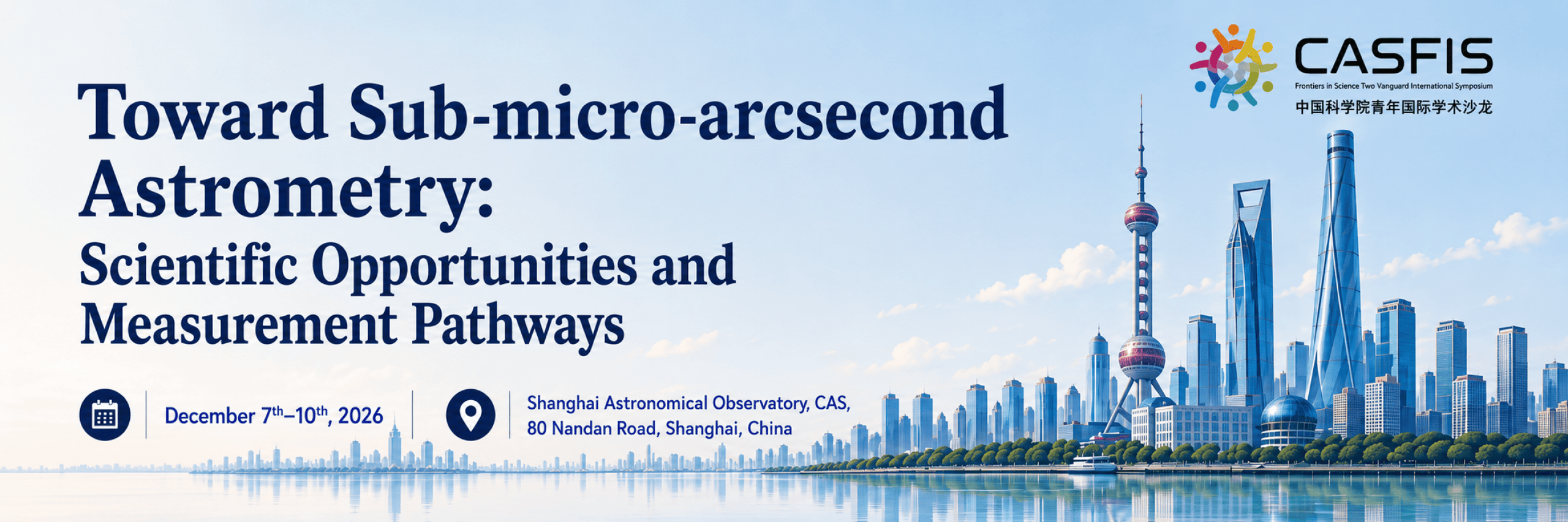
Toward Sub-micro-arcsecond Astrometry: Scientific Opportunities and Measurement Pathways
(FIRST CIRCULAR)
Funded by the Bureau of International Cooperation, Chinese Academy of Sciences, and hosted by the Shanghai Astronomical Observatory, Chinese Academy of Sciences, the symposium will bring together international experts and young researchers to discuss the science and measurement pathways toward sub-micro-arcsecond astrometry.
Dates: December 7, 09:00 - December 10, 18:30, 2026
Venue: Shanghai Astronomical Observatory, CAS, 80 Nandan Road, Xuhui District, Shanghai, China
Registration deadline: October 26, 2026
Website: https://conf.koushare.com/conf/casfis-smastro2026
1. Scope and Objectives
Astrometry offers a unique dynamical view of the Universe through precise measurements of positions, parallaxes, proper motions, orbital motions, and relativistic perturbations. These measurements underpin studies of planetary-system formation, stellar and compact-object evolution, the structure and dynamics of the Milky Way, celestial reference frames, and tests of gravity.
Gaia has established an unprecedented astrometric foundation, yet major science cases,from terrestrial exoplanets and compact-object systems to gravitational-wave astrometric signals and near-field cosmology, require greater precision, long-term stability, and systematic-error control. The symposium will provide a small, focused, discussion-oriented forum to examine major scientific and technological challenges, possible solutions, and future directions, and to identify priorities for space-borne sub-micro-arcsecond astrometry and international collaboration.
2. Scientific Themes
(1)Science Drivers: Celestial reference frames, Galactic and Local Group dynamics, near-field cosmology, tests of gravity, terrestrial exoplanets, and gravitational-wave astrometric signals.
(2)Measurement Pathways: Optical and focal-plane design, detectors, calibration, laser metrology, observing strategies, and differential or pseudo-differential concepts.
(3)Relativistic Astrometric Modeling and Ephemeris Support: Relativistic observation models, light propagation, spacecraft motion, astrometric observables, and high-precision Solar System ephemerides.
(4)Roadmap Toward Sub-micro-arcsecond Astrometry: Scientific priorities, technical bottlenecks, calibration requirements, mission concepts, and international cooperation.
3. Program and Participation
The four-day symposium will include scientific sessions, discussion sessions, and a final synthesis discussion on the afternoon of Day 4. The invited-speaker list and detailed program will be announced on the symposium website.
(1)Oral contributions: Participants wishing to give a talk should submit a title and abstract as requested on the registration page. Submissions will be reviewed by the Scientific Organizing Committee.
(2)
Early-career support: Selected contributions from postdoctoral researchers and PhD students may be considered for limited financial support, subject to available funds and the final decision of the Scientific Organizing Committee. Interested applicants should contact the organizers early.
4. Registration and Practical Information
Online registration is required. The deadline is October 26, 2026. There is no registration fee; participants are responsible for their own travel, accommodation, and personal expenses.
Online registration: Register Now
Accommodation and transport: Participants should book their own accommodation. Suggested nearby hotels and travel guidance are available on the symposium website. Assistance may be requested in advance, subject to availability.
Visa invitation letters: Participants requiring an official invitation letter should register and contact the organizers as early as possible. The required passport and travel information is listed on the Contact Us page. Participants remain responsible for checking the latest visa requirements with the relevant authorities.
5. Organization
Hosted by: Shanghai Astronomical Observatory, Chinese Academy of Sciences
Scientific Organizing Committee
Zhaoxiang Qi (SHAO-CAS, Co-Chair), Mario G. Lattanzi (OATo-INAF / SHAO-CAS, Co-Chair), Zi Zhu (NJU), Jiacheng Liu (NJU), Yuqiang Li (YNAO), M. Crosta (OATo-INAF), Jian Gao (BJNU), Qingyu Peng (JNU), Shilong Liao (SHAO-CAS)
Local Organizing Committee
Shilong Liao (SHAO-CAS, Chair), Zhenghong Tang (SHAO-CAS, Co-Chair), Qiqi Wu (SHAO-CAS), Shaohong Zhang (SHAO-CAS), Ye Ding (SHAO-CAS)
6. Contact
Shilong Liao:shilongliao@shao.ac.cn +86 21 3477 5275
Qiqi Wu:wuqiqi@shao.ac.cn
Shaohong Zhang:zhangshaohong@shao.ac.cn
附件下载:


