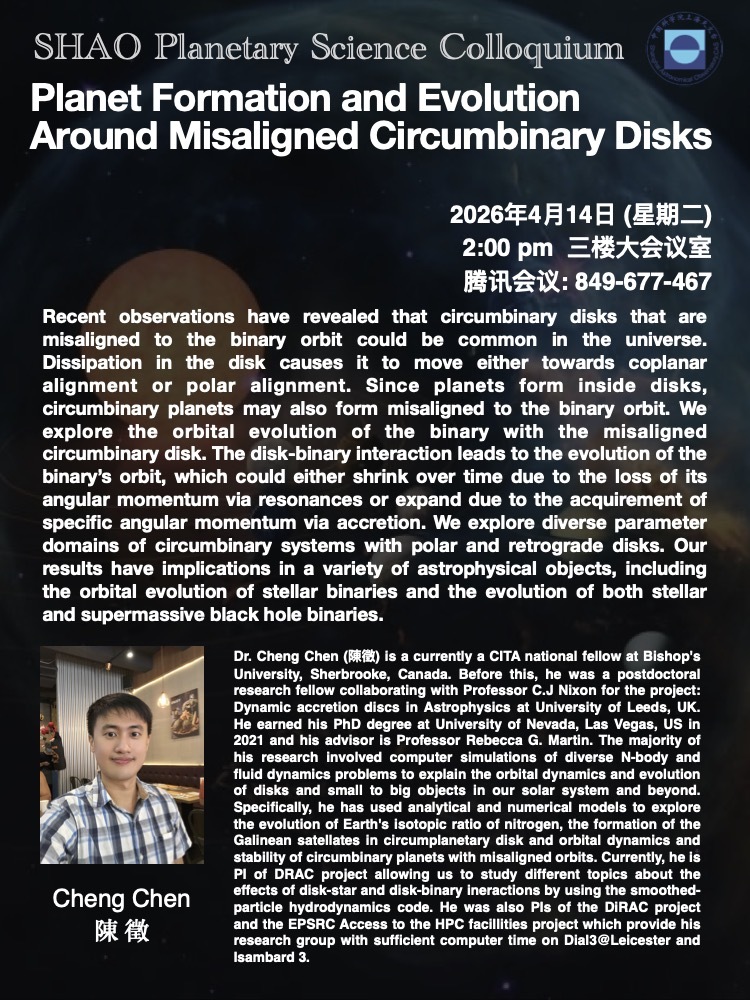
Title: Planet Formation and Evolution Around Misaligned Circumbinary Disks
Speaker:Cheng Chen
Date: Tuesday, April 14, 2026
Time: 2:00 PM
Venue: Large Meeting Room, 3rd Floor
Tencent Meeting: 849-677-467AbstractRecent observations have revealed that circumbinary disks that are misaligned to the binary orbit could be common in the universe. Dissipation in the disk causes it to move either towards coplanar alignment or polar alignment. Since planets form inside disks, circumbinary planets may also form misaligned to the binary orbit. We explore the orbital evolution of the binary with the misaligned circumbinary disk. The disk-binary interaction leads to the evolution of the binary’s orbit, which could either shrink over time due to the loss of its angular momentum via resonances or expand due to the acquirement of specific angular momentum via accretion. We explore diverse parameter domains of circumbinary systems with polar and retrograde disks. Our results have implications in a variety of astrophysical objects, including the orbital evolution of stellar binaries and the evolution of both stellar and supermassive black hole binaries.About the SpeakerDr. Cheng Chen (陳徵) is a currently a CITA national fellow at Bishop's University, Sherbrooke, Canada. Before this, he was a postdoctoral research fellow collaborating with Professor C.J Nixon for the project: Dynamic accretion discs in Astrophysics at University of Leeds, UK. He earned his PhD degree at University of Nevada, Las Vegas, US in 2021 and his advisor is Professor Rebecca G. Martin. The majority of his research involved computer simulations of diverse N-body and fluid dynamics problems to explain the orbital dynamics and evolution of disks and small to big objects in our solar system and beyond. Specifically, he has used analytical and numerical models to explore the evolution of Earth's isotopic ratio of nitrogen, the formation of the Galinean satellates in circumplanetary disk and orbital dynamics and stability of circumbinary planets with misaligned orbits. Currently, he is PI of DRAC project allowing us to study different topics about the effects of disk-star and disk-binary ineractions by using the smoothed-particle hydrodynamics code. He was also PIs of the DiRAC project and the EPSRC Access to the HPC facillities project which provide his research group with sufficient computer time on Dial3@Leicester and Isambard 3.