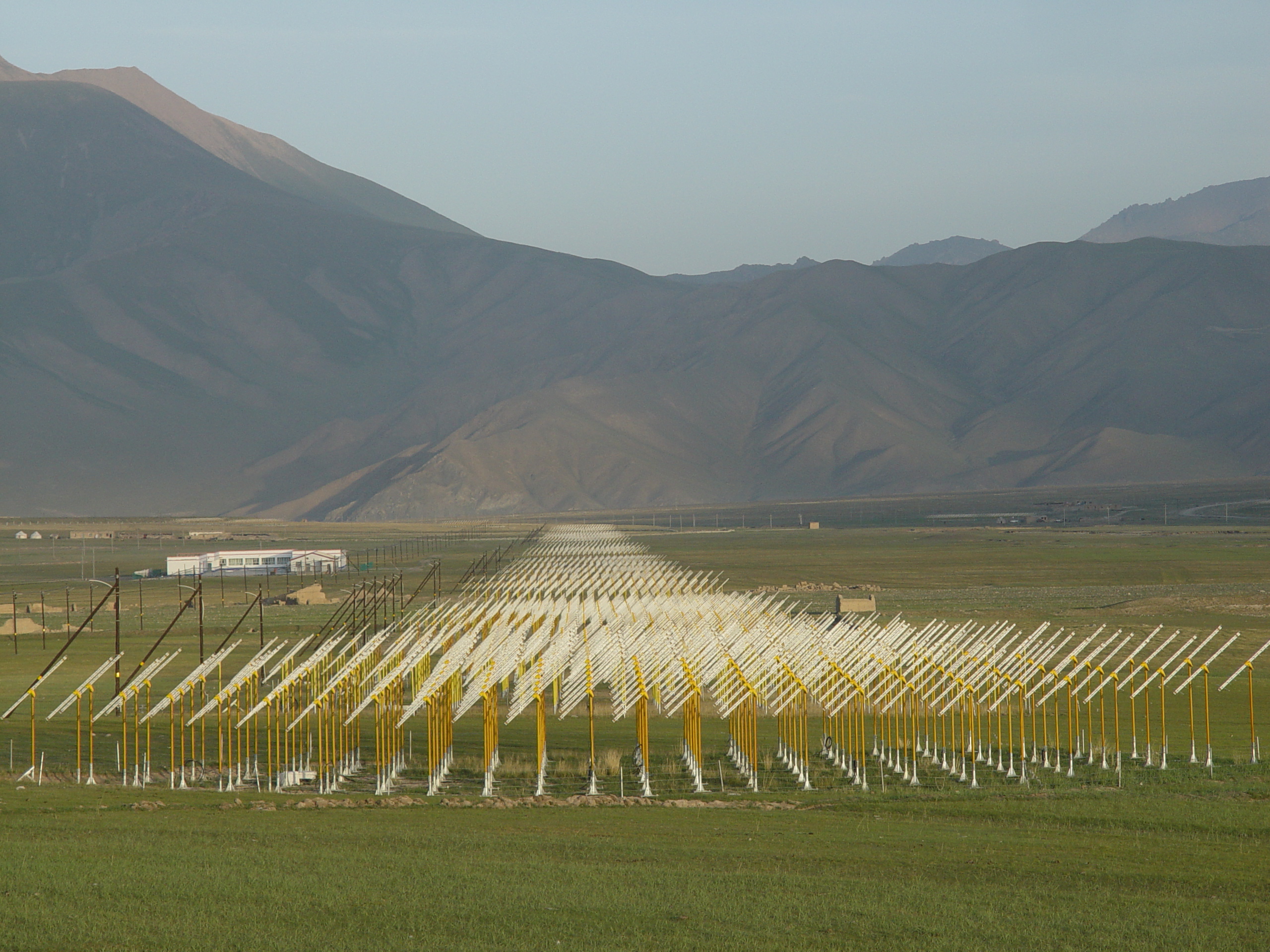
21 CentiMeter Array
The 21 CentiMeter Array (21CMA) is a ground-based radio interferometer sited in Ulastai valley of western China. The key science project of 21CMA is detection of the Epoch of Reionization (EoR). 21CMA consists of 81 stations and a total of 10,287 log-periodic antennas. The antennas are deployed in two perpendicular arms along East-West (EW) and North-South (NS) directions. The longest EW baseline is 6.1km and the longest NS baseline is 4km. The spacings of the 81 stations are chosen such that a sufficiently large number of redundant baselines and a good uniform UV coverage can be guaranteed.
Each 21CMA antenna element has 16 pairs of dipoles with lengths varying from 0.242m to 0.829m, optimized to cover a frequency range of 50 MHz to 200 MHz. All antennas are fixed on the ground and point at the North Celestial Pole (NCP) region for the sake of simplicity and economy. It also allows us to observe the sky region around NCP for 24 hours a day through the whole year. Therefore, it enables us reach a higher sensitivity in the region around NCP in a relatively short time.
Phase delayed coaxial cables are used to combine the signal from each antenna for each station, and the output signal is digitized at a sampling rate of 400 MHz with 8 bit precision to accommodate the frequency bandwidth of 200 MHz. The signal below 50 MHz is filtered out.
Fast Fourier Transform and correlations are performed in software by a cluster of 83, dual core Intel(R) Xeon(TM) servers, equipped with gigabit ethernet networks (PCI-E 10-Gbs 4X) and a high speed network (Infiniband) switch (CISCO SFS-7008P). The 200 MHz bandwidth is divided into 8192 frequency channels, then the frequency resolution of 21CMA is 24.4 kHz. Finally the data in each frequency channel are integrated for about 3s in memory before they are output to a disk array of 32 terabytes.
低频射电望远镜阵列21CMA位于新疆天山深处,行政区归属于巴音郭楞蒙古自治州和静县阿拉沟乡的乌拉斯台查汗村,台址位于海拔2650米的高原上,阵列的中心地理坐标是北纬42度56分和东经86度41分。当地四周由海拔3千米以上的群山环绕,山体可以作为阻挡来自周边地区电磁辐射的天然屏障,山间东西、南北走向的两条平坦的山谷为布设望远镜的两条正交基线创造了良好环境。
21CMA的基本接收单元是长度为2.2米、由16对阵子组成的对数周期天线,天线的设计最佳的工作波段是70-200MHz,但是可以覆盖50-300MHz的更宽波段。所有的天线固定在地面,指向北天极。每个天线阵有127个单元天线组成。沿北天极方向俯视,每个天线阵是一个边长为10.5米的正六边形。各单元天线间以低噪声电缆相连接,以保证来自北天极方向的信号相位相同来确定电缆线的长度。在150MHz观测频率,每个天线阵等效接收面积为218平方米。21CMA由东西、南北两条基线组成,东西基线长度为2.74千米,南北基线长度为4.1千米。21CMA东西和南北两条基线上分布着41+40个天线阵,总共包括10287个单元天线。
目前21CMA在东西40组阵列和南北2组阵列安装了低噪声放大器(LNA),LNA的工作波段为50-200MHz,噪声温度为50K,增益为22.5dB,平坦度小于0.5 dB。经过第一级前置LNA放大后的信号再次经过低噪声电缆传输以“四合一”叠加的方式最终进入接受电路板,经过50-200MHz带通滤波、两级27.5dB中级放大、两次50-200MHz滤波后,进入光发射机,信号通过连接每一天线阵列至控制中心的光缆传输至室内光接收机,最终恢复模拟信号进入ADC。整个接收机的总放大率为87.5dB,其中包括了10dB的光发射机增益。实测表明,21CMA接收系统温度可以控制在60K左右。
进入采集系统的模拟信号通过ADC被数字化,21CMA采用的APEX-PCI-5111单通道ADC,采样率为400MSPS,精度为8bit,信噪比大于40dB。21CMA采集系统有83台双核Intel(R) Xeon(TM) 服务器组成,CPU主频为3.60GHz,内存为12GB,采用Infiniband(无限带宽)技术通过81个MHQH191B-XTR高速网卡与96口高速交换机FRID DIRECTOR 4200相连接,以满足81路天线阵列节点数据两两相关形成3240组基线的要求。目前21CMA采集系统讲200MHz带宽分为8192个频率通道,频率分辨率为24.4kHz。
每组天线的信号经ADC数字化,在8192通道上以软件形式实施离散FFT, 经过Infiniband网络与其它服务器通信,完成互相关和自相关运算,然后累加各基线和各频率通道的相关数据,每隔3s将相关数据写入硬盘,后进行后续数据处理。