


Pushing the Frontiers of Astronomical Adaptive Optics
Talk Abstract:
Adaptive optics (AO) continues to revolutionize observational astronomy by compensating for atmospheric turbulence, but the demands of next-generation telescopes require breakthroughs in sensitivity, speed, cost, and scalability. My group is developing new approaches that advance these fronts through innovations in wavefront sensing, control, instrument design, and photonic integration.
I will first highlight our work on pyramid wavefront sensing in the near-infrared, demonstrated in the MMT AO exoPlanet characterization System (MAPS) at the 6.5-meter MMT Observatory. These developments extend AO performance to fainter guide stars and longer wavelengths—capabilities that will be essential for future large telescopes. Building on this foundation, we are applying artificial-intelligence–based control algorithms that use predictive models to reduce servo lag and enhance correction stability for very faint guide stars, paving the way for higher-performance AO systems.
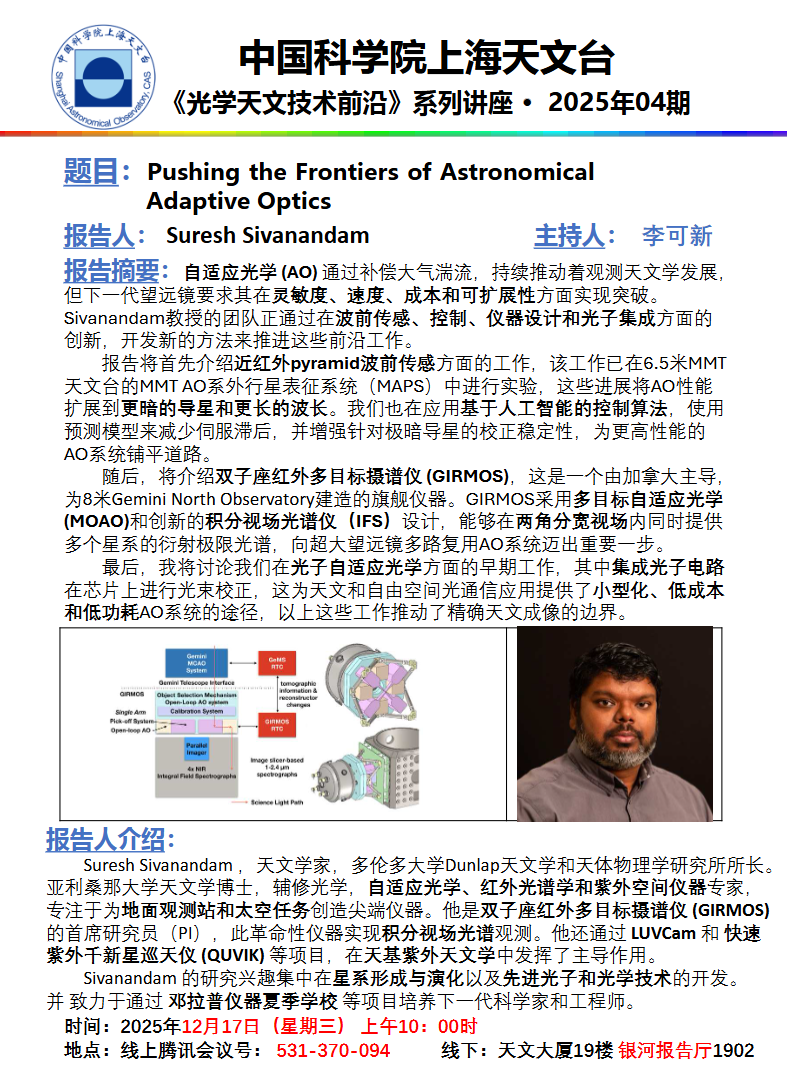
I will then present the Gemini Infrared Multi-Object Spectrograph (GIRMOS), a flagship Canadian instrument now under construction for the 8-meter Gemini North Observatory. GIRMOS employs multi-object adaptive optics (MOAO) to deliver simultaneous diffraction-limited integral-field spectroscopy of multiple galaxies across a wide two-arcminute field. This architecture represents a major step toward the multiplexed AO systems envisioned for the Extremely Large Telescopes.
Finally, I will discuss our early work on photonic adaptive optics, where integrated photonic circuits perform beam correction on a chip - offering a pathway to miniaturized, low-cost, and low-power AO systems for both astronomical and free-space optical communication applications.
Together, these efforts define a new generation of astronomical AO systems that merge advanced sensing, intelligent control, and photonic technology to push the boundaries of precision imaging from the ground and beyond.
Bio:
Suresh Sivanandam is an astronomer and the Director of the Dunlap Institute for Astronomy and Astrophysics at the University of Toronto. He obtained his PhD at the University of Arizona in Astronomy with a minor in Optical Sciences. His work bridges the frontiers of astronomy, engineering, and technology development, with a focus on creating cutting-edge instrumentation for both ground-based observatories and space missions.
An expert in adaptive optics, infrared spectroscopy, and ultraviolet space instrumentation, Sivanandam has led numerous international projects that expand our ability to explore the cosmos. He is the Principal Investigator of the Gemini Infrared Multi-Object Spectrograph (GIRMOS), a revolutionary instrument designed to capture detailed infrared spectra of distant galaxies, and has played a leading role in space-based ultraviolet astronomy through projects such as LUVCam and the upcoming Quick Ultraviolet Kilonova Surveyor (QUVIK) mission.
Sivanandam’s research interests center on galaxy formation and evolution and the development of advanced photonic and optical technologies. His work has been recognized for its innovation in translating cutting-edge laboratory technology into operational observatory systems. Sivanandam is deeply committed to training the next generation of scientists and engineers through programs such as the Dunlap Instrumentation Summer School, which brings students from around the world to gain hands-on experience in building and using astronomical instruments.
附件下载:


